
Key Takeaways
- Plasma cutting is the faster, more efficient choice up to roughly 2″–2.5″ on carbon steel.
- Oxyfuel takes over as the better process from about 2″ through 24″-plus.
- Oxyfuel only cuts carbon and low-alloy steel, never stainless steel or aluminum.
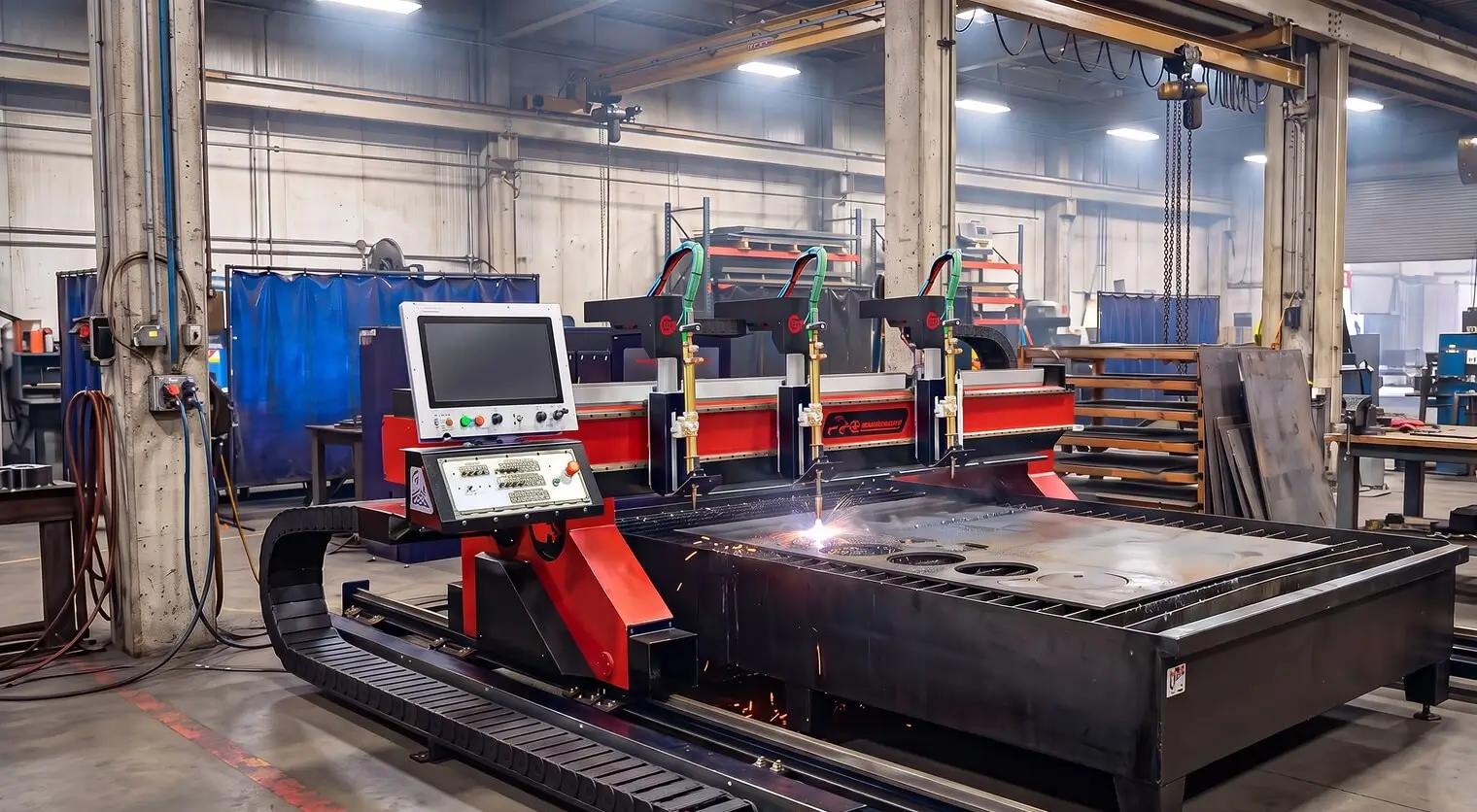
- A single oxyfuel gantry can run up to 12 torches at once for high-volume plate cutting.
- CSI’s Raptor, SaberCut, Kodiak, and Cobra each match a different thickness, material, or bevel requirement.
Jump Ahead
Plasma is faster on thin and medium plate, but it runs out of room fast. Most high-definition plasma systems stay efficient up to roughly 2″–2.5″ on carbon steel. Past that point, oxyfuel takes over and holds the advantage from about 2″ up through 24″-plus, which is why it’s still the default process for heavy plate fabrication at structural mills, shipyards, and mining equipment manufacturers.
The two processes aren’t competitors so much as a relay: plasma owns the thin-to-medium range, oxyfuel owns everything above it. Picking wrong in either direction costs cycle time, consumables, or both. Here’s where the line actually falls, what each process can and can’t cut, and which CSI machine covers each end of the range.
What Is CNC Plasma Cutting?
CNC plasma cutting uses a jet of ionized gas — plasma — to melt and blow through electrically conductive metal, guided by a computer-controlled torch. It’s the process behind most high-speed, high-definition cutting on steel, stainless steel, and aluminum up to roughly 2″–2.5″ in an efficient production setting, and it can push into thicker material on systems built for it, with some loss of speed and edge quality as thickness climbs.
Advantages of CNC Plasma Cutting
- Speed on thin-to-medium plate. Plasma cuts several times faster than oxyfuel at the same thickness up to its efficient range.
- Material versatility. Unlike oxyfuel, plasma cuts stainless steel and aluminum in addition to carbon steel, since it doesn’t rely on oxidation chemistry.
- Cleaner starts. Plasma pierces material almost instantly, with no preheat cycle.
- Better edge quality on thinner stock. Reduces or eliminates secondary finishing on parts destined for weld-out or paint.
What Is Oxyfuel Cutting?
Oxyfuel cutting burns a mix of fuel gas and oxygen to preheat steel to its ignition temperature, then introduces a high-pressure oxygen stream that oxidizes the metal along the cut line. It’s a chemical process, not an electrical one, which is what gives it both its strength on thick plate and its one hard limitation.
Material limitation: Oxyfuel only works on ferrous metals, including carbon and low-alloy steel. It cannot cut stainless steel or aluminum, because neither oxidizes the way carbon steel does under an oxyfuel torch. Shops running mixed-material jobs need a plasma or dual-process system like Kodiak for the stainless and aluminum work, and oxyfuel for the carbon steel.
Oxyfuel Cutting vs. CNC Plasma Cutting: Key Differences
| Factor | CNC Plasma | Oxyfuel |
|---|---|---|
| Efficient thickness range | Up to ~2"–2.5" | ~2" through 24"+ |
| Materials | Carbon steel, stainless steel, aluminum | Carbon and low-alloy steel only |
| Cutting speed | Faster on thin-to-medium plate | Slower per cut, but scales with multi-torch setups |
| Startup | Instant pierce, no preheat | Requires a preheat cycle |
| Cost profile | Higher equipment and consumable cost | Lower running cost on heavy plate |
| Best fit | Mixed-material shops, thinner production runs | Heavy carbon steel plate, high-volume multi-torch cutting |
Industry Applications and Use Cases
Structural steel mills cutting beams, plate girders, and connection plates in the 1″–4″ range lean on multi-torch oxyfuel gantries to move volume without burning through plasma consumables at that thickness. A twelve-torch oxyfuel setup on a single gantry cuts far more linear footage per hour than running the same job through a plasma system sized for that plate.
Shipbuilding hull plate regularly runs 1″–2″ and thicker for hull sections, frames, and bulkheads — squarely in oxyfuel’s range, and a process shipyards have standardized on for decades because of its reliability at scale on carbon steel.
Mining equipment manufacturers building wear plate, bucket structures, and heavy chassis components routinely work in 2″–6″ carbon steel, where a dual-process machine like Kodiak lets a shop switch to plasma for thinner brackets and stainless wear components on the same platform, without moving the job to a second machine.
Choosing the Right Cutting Method for Your Operation
The decision comes down to three questions: What thickness are you cutting most often? Are you cutting anything besides carbon steel? And do parts need a beveled edge for welding?
- Thin-to-medium plate, mixed materials: Raptor delivers plasma-only cutting up to 6.25″ with 200–800 amp Hypertherm systems — built for shops running high-duty-cycle plasma production without an oxyfuel requirement.
- Heavy carbon steel plate only, no mixed materials: SaberCut is oxyfuel-only up to 24″, with 1 to 12 torches standard — the straightforward answer for shops cutting nothing but thick carbon steel at volume.
- Both thin and thick plate, or mixed materials, on one machine: Kodiak covers plasma up to 6.25″ and oxyfuel up to 24″ on the same platform, cutting mild steel, stainless, and aluminum with plasma and carbon steel with oxyfuel.
- Bevel-plus-thickness matters — parts need a weld-ready edge and the plate is thick enough to need oxyfuel: Cobra cuts full-contour bevels up to ±52° with plasma up to 6.25″ and oxyfuel up to 24″, eliminating a separate manual weld-prep step.
Many heavy-plate operations run more than one of these side by side. For example, a Raptor for thin production work and a SaberCut or Kodiak for the heavy carbon steel jobs that don’t make sense on plasma. Talk with a CSI engineer about your thickness range and material mix before specifying a system.
FAQs
Is there a point where a plate is too thick even for oxyfuel, and how do fabricators handle those extreme cases?
Standard oxyfuel systems, including SaberCut and Kodiak, are rated up to 24″ on carbon steel, which covers the overwhelming majority of heavy-plate fabrication work. Beyond that, shops typically move to multi-pass cutting, saw cutting, or a custom-engineered oxyfuel configuration built for the specific job — CSI’s Custom Engineered Solutions line covers that case.
Can oxyfuel cut stainless steel or aluminum, or is it limited to carbon and low-alloy steel?
Oxyfuel is limited to carbon and low-alloy steel. The process depends on the metal oxidizing under a high-pressure oxygen stream, and stainless steel and aluminum don’t oxidize that way. Cutting those materials requires plasma — either a dedicated plasma system like Raptor, or a dual-process machine like Kodiak or Cobra that adds oxyfuel capability for the carbon steel portion of the job.
How many oxyfuel torches can realistically run on one gantry for high-volume steel service center work?
CSI’s oxyfuel-capable machines, including SaberCut and Kodiak, support 1 to 12 torches standard on a single gantry. Steel service centers running high plate volumes typically configure toward the upper end of that range to maximize linear cutting output per pass.