
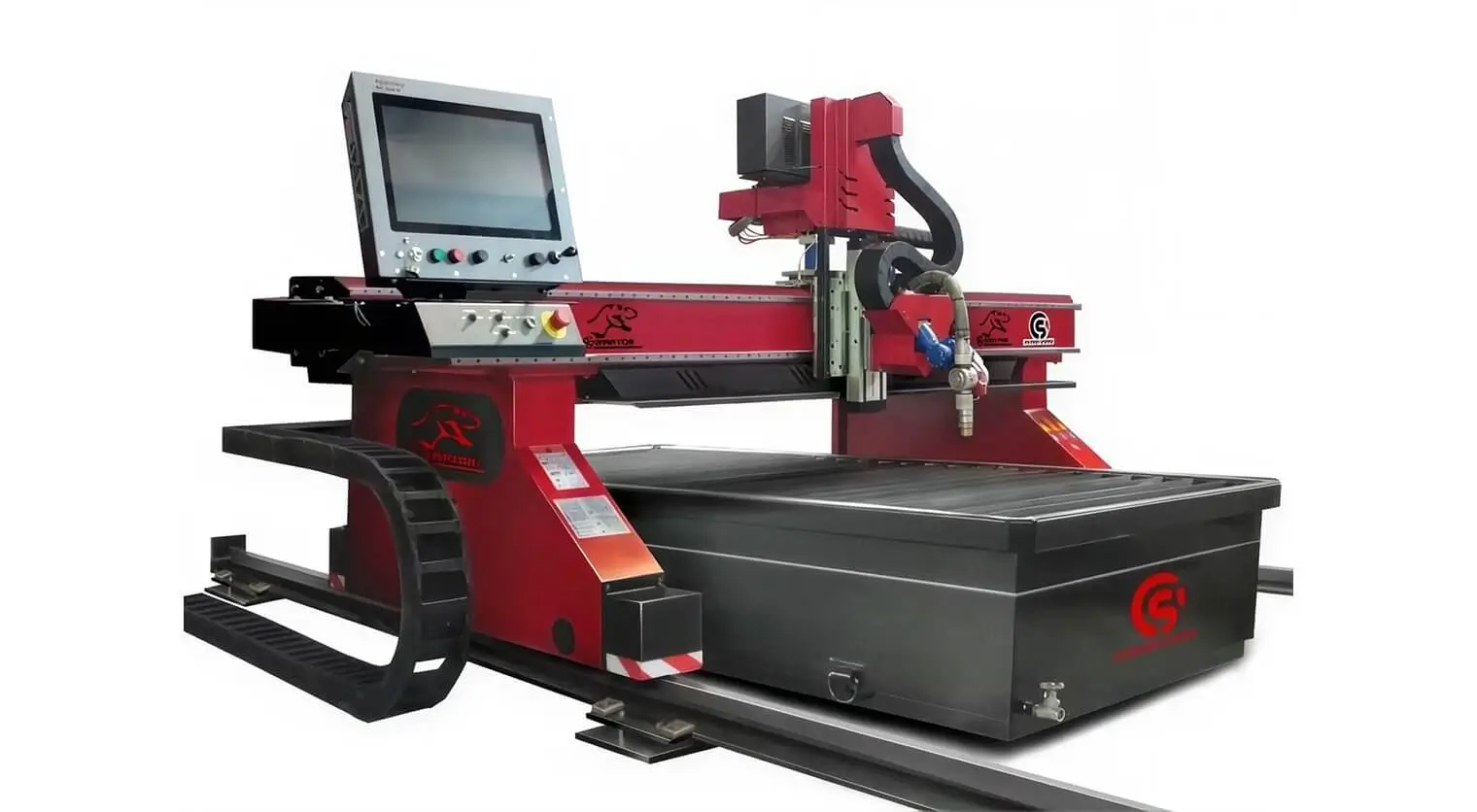
Every part that leaves the cutting table with a square edge still needs a bevel before it can go to weld. That means a second stop at a grinder or mill, a second setup, and a second round of handling before the part is actually ready for the welder. Plasma bevel cutting removes that stop entirely. A CNC plasma beveling machine cuts the bevel and the land area in the same pass as the profile, so the part comes off the table already weld-ready. For shops running pressure vessels, structural steel, or heavy plate fabrication, that single change removes one of the largest sources of non-value-added labor on the floor.
The Hidden Cost of Manual Weld Prep
Grinding a bevel by hand is slow, and it’s inconsistent from operator to operator and from part to part. A bevel that’s a few degrees off, or a land area that varies along the cut, creates weld defects that get caught in inspection, not before it. Every part that goes to a grinder is also a part that sits in a queue, waiting on labor that could be running the next job. When a shop is trying to eliminate manual weld prep grinding from its process, the fix isn’t a faster grinder. It’s removing the grinding step altogether.
What Plasma Bevel Cutting Actually Does
A plasma bevel head tilts the torch to a programmed angle and follows the part profile, cutting the bevel face and the flat land in one motion. The part comes off the table ready for the fit-up table, not the grinding bay. Cutting Systems’ Cobra CNC plasma bevel-cutting machine is built around this exact job: cutting bevel angles up to 52 degrees with Hypertherm’s XPR power supplies, producing a weld-ready edge without a second operation.
Full Contour Bevel Cutting Solves What Straight-Line Bevelers Can’t
Older bevel heads hold an angle in a straight line but lose accuracy the moment the profile curves. That’s a real limitation on parts with radiused corners, flanges, or contoured shapes, which is most of what a structural or pressure vessel shop actually cuts. Holding the bevel angle consistent through curves and complex geometry, not just on the straight runs, is what separates a machine that handles simple plate work from one that handles the parts a shop is actually running.
What to Look for in a Weld Prep Beveling Machine
Not every plasma table with a bevel option performs the same on the floor. A few specifics separate a machine that actually delivers on the promise from one that just advertises it:
- Bevel range and repeatability. Look for a documented angle range (Cobra runs up to ±52° with XPR, ±45° with HPR) and consistent results part to part, not just on a demo cut.
- Torch height control. Automated THC holds cut quality as plate thickness or surface condition varies, which keeps bevel geometry accurate across a full run.
- Power supply match. Bevel quality depends on plasma power matched to material thickness. A system running 200 to 800 amps covers thin gauge through heavy plate without swapping equipment.
- Contour capability. Confirm the head holds angle through curves, not just straight cuts, if contoured parts are part of the mix.
Where Automatic Bevel Cutting Pays Off
This capability earns its keep fastest in shops running repeat volumes of parts that need consistent, code-compliant weld edges: pressure vessel heads and shells, structural steel connections, shipbuilding plate, and heavy equipment fabrication. In each case, the labor saved isn’t just the grinding time. It’s the setup, the handling, and the inspection rework that comes from inconsistent manual prep. A shop cutting fifty parts a week can move that entire batch through weld prep in the time it used to take to prep the first ten by hand.
Fabricators evaluating a bevel-capable table should weigh the cutting envelope, the bevel range, and the power supply against the parts they actually run, not just the parts in a spec sheet. Cutting Systems builds the Cobra to handle that range of work on American-made tables backed by direct technical support.
Frequently Asked Questions
What is plasma bevel cutting?
Plasma bevel cutting is a CNC process that tilts the plasma torch to a set angle while it follows a part’s profile, cutting the bevel face and flat land area in the same pass as the outer cut. The part comes off the table with a finished, weld-ready edge instead of a square edge that still needs grinding.
How is a beveled edge different from a square-cut edge for welding?
A square-cut edge has a flat 90-degree face that has to be ground or milled into a bevel before two pieces of plate can be joined for most structural or pressure vessel welds. A beveled edge is already shaped to the joint design, so it goes straight from the cutting table to fit-up.
What bevel angles can a CNC plasma system cut?
It depends on the plasma power supply. Cutting Systems’ Cobra cuts bevel angles up to 52 degrees with Hypertherm’s XPR power supplies and up to 45 degrees with HPR power supplies, covering the joint angles most structural and pressure vessel work calls for.
Does plasma bevel cutting slow down production compared to a straight cut?
No. The bevel head cuts the angle in the same pass as the part profile, so there’s no added cutting time in the way there would be for a separate grinding or milling step. The time saved shows up downstream, in the labor and queue time that manual weld prep used to take.
Can plasma bevel cutting handle curved or irregular parts, or only straight edges?
A machine built for it can. Cutting Systems’ Cobra holds a consistent bevel angle around radiused corners and contoured profiles, not just on straight runs, which matters for flanges, heads, and shells that aren’t simple rectangles.
Talk to a Cutting Systems Specialist

How To Choose a Plasma Cutter
Choosing a plasma cutter for your machine shop is a critical part of managing your CNC workflow. With new technologies […]

7 Questions to Ask When Buying a CNC Cutting Machine
Looking into getting a new CNC cutting machine? Customers are always wondering what to ask before buying a CNC machine. […]
Heavy Plate Fabrication: When to Deploy Oxyfuel Cutting Over High-Definition Plasma
Key Takeaways Plasma cutting is the faster, more efficient choice up to roughly 2″–2.5″ on carbon steel. Oxyfuel takes over […]